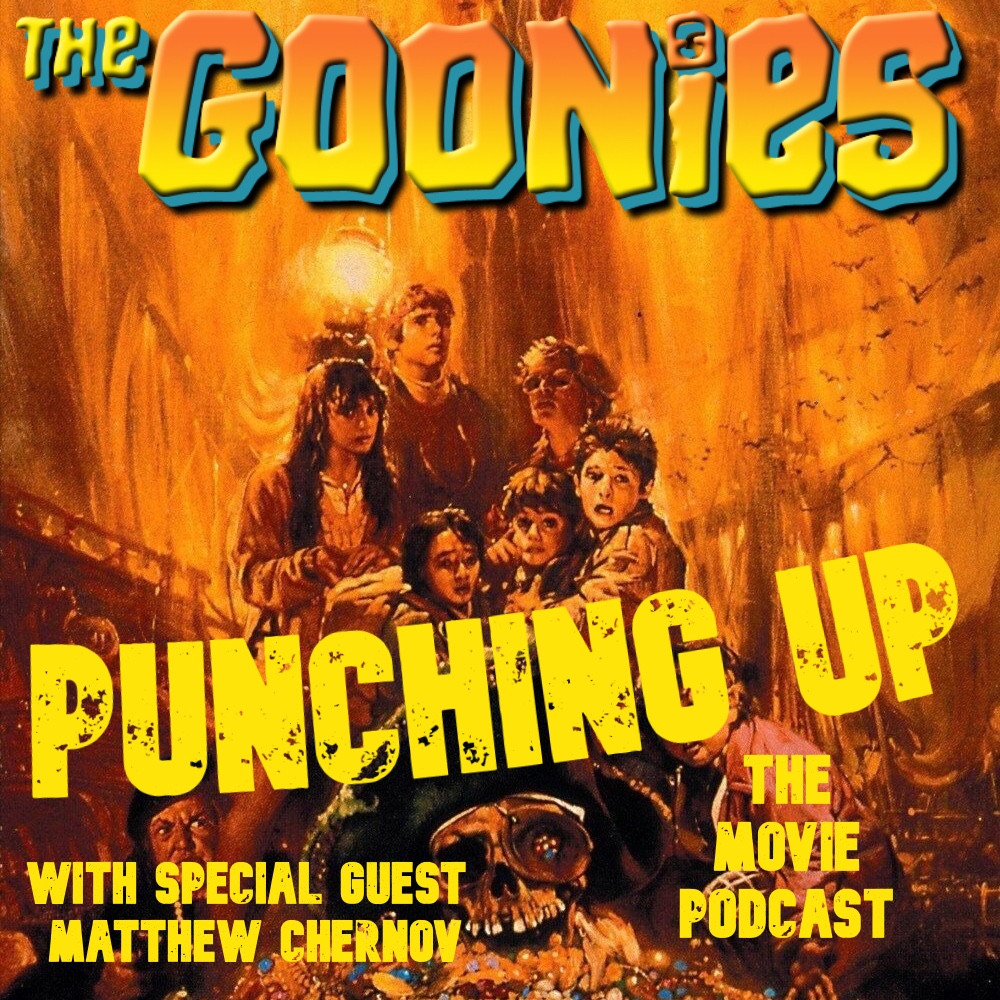
A first for the punching up team. Damian and Adam have somehow acquired a special guest, Matthew Chernov, the estimable LA film journalist, screenwriter and presenter of the magnificent How The West Was Cast podcast. Matthew is an enormous fan of The Goonies, that beloved 1985 family friendly (if you discount that bit where the federal agent gets murdered and his corpse is locked in a freezer with a child, as well as the ceramic penis joke) Spielberg produced adventure movie. It’s fair to say that Damian is not fan. And despite being a teenager in the 1980s, Adam hadn’t actually seen The Goonies until the day before recording the pod and is keeping his cards close to his chest. So, will Adam stand by his friend of 35 years and stick one on The Goonies and Matthew Chernov. Or will he tag-team Matthew and gang up on Damian, metaphorically throwing his old mate under the bus in defence of Mikey, Brand, Mouth, Chunk, Data, Andy and the Goonie nobody likes very much that was played by that girl who happens to be David Carradine from Kill Bill and Kung Fu’s niece? Join us and find out.
Get in touch :O) by sending us an email @punchingupmoviepodcast@gmail.com Follow us on Instagram @ punchingupmoviepodcast
“Just when I thought I was out…they pulled me back in”
In 2023 Justin Mollner wrote and directed the serial killer thriller*, Strange Darling, which took me by surprise. Nowadays, that’s all I ask of my media. To be surprised and moved in some way shape or form. His writing and direction did just that.
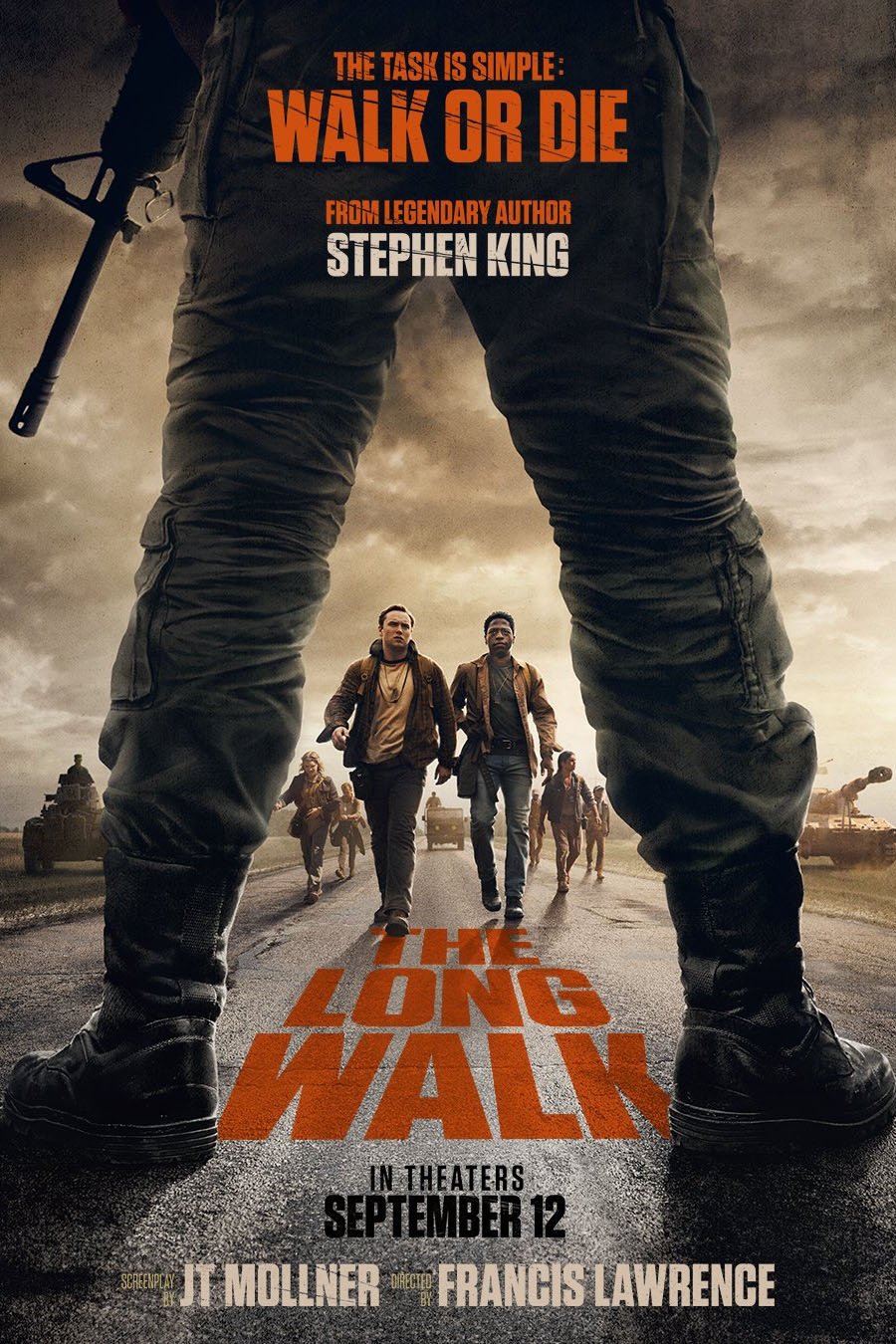
FFWD to today (Wednesday 24th September 2025) and I just came back from seeing The Long Walk, based on Stephen King’s (as Richard Bachman) book of the same name, directed by Francis Lawrence and written/adapted by Justin Mollner. I’m a fan. Of the film and of Mollner’s writing.
Let’s go back to April 2022 and having taken a hiatus from writing I was inspired to put fingers to keyboard to write about one of my favourite films for a long time. Everything Everywhere All at Once. That film did something. Surprised, moved and excited me for the first time in a while. This prompted me to get back to my movie blog and write again.
This year I’ve been slack and I haven’t written anything since October 2024. 10 months.
And just when I thought I was out….. That’s a joke, really. I needed to be inspired to get back on the writing horse and here we are. Giddyup.
David Jonsson as McVries, Cooper Hoffman as Garraty, Jordan Gonzalez as Harkness, Ben Wang as Olson, and Tut Nyuot as Baker in The Long Walk. Photo Credit: Murray Close/Lionsgate
The Long Walk is a beautiful, tragic, human story set in a not too distant dystopian future where a second civil war (pertinent/timely???) has left America financially destitute. The Long Walk refers to a national yearly sport where fifty teenage boys are selected randomly to partake in a survival walk that ends with one winner, while the other 49 all get their tickets stamped.
Battle Royale came to mind as did The Hunger Games, which if we’re being honest, although still decent, is really Battle Royale lite. A savage game that pits kids against each other with the losers all being dispatched in some messed up way. **
The Long Walk reminded me of another of King’s film adaptations and one of my all time favourite films, Stand By Me. Friendship, trauma and a human story that contains moments of beauty and profound and genuine poetry. This one shares DNA with that classic.
Mark Hamill as The Major in The Long Walk. Photo Credit: Murray Close/Lionsgate
This adaptation has been a long time coming. In 1988, George A Romero was touted to make it and when that didn’t happen, Frank Darabont (who had previously directed two of the great Stephen King adaptions and one that is probably considered among the greatest films of all time*** The Shawshank Redemption and followed that with The Green Mile) tried unsuccessfully to get it made.
Then James Vanderbilt (Zodiac/The Amazing Spider-Man) and André Øvredal (Trollhunters, Scary Stories to Tell in the Dark, The Last Voyage of the Demeter) were also attached along the way. In 2023, Lionsgate committed to producing the film with The Hunger Games director, Francis Lawrence**** attached.
Lawrence directs his incredibly talented cast headed by Cooper Hoffman, who is doing his Dad proud and English actor and RADA alum David Jonsson, who was recently in Alien:Romulus*****
Other young support comes from Garrett Wareing, Charlie Plummer, Ben Wang, Joshua Odjick and another couple of Brits, Tut Nyuot and Jojo Rabbit’s Roman Griffin Davis. Each of them give great work that will hopefully propel them into future great performances. Although, unfortunately acting is not a meritocracy. Even with great success, offers are not always forthcoming. I hope that these young actors navigate their careers well and are rewarded for the work they did in this film.
The always excellent, Judy Greer gives a heart-wrenching performance as the mother of Cooper Hoffman’s Ray Garraty and the mighty Mark Hamill gives an unwavering turn as The Major, the man in charge of the walk. Hamill, who has had a tremendous run throughout his life is turning in some of the best performances in this stage of his career. The Life of Chuck and The Fall of the House of Usher, both helmed by Mike Flanagan are two that come to mind.
Jeremiah Fraites (co founder of folk-rock group The Lumineers) scores the film with a stunning, subtle soundtrack that never over-eggs the film and always supports the action on screen. It is well worth a listen as a standalone piece of music (see below :O)). He had previously worked with Lawrence on a couple of tunes for the Hunger Games movies and this is his feature film composing debut.
The upcoming Edgar Wright new adaptation of The Running Man shares Venn diagram with The Long Walk and both being adapted from King’s works looks to be the third great adaptation this year after the excellent The Life of Chuck.
I have read very little King over the years and I think it’s time to change that. I was always a bit snobbish about it and don’t think I had any right to be so. Judgement error. My bad. I’ve just ordered the book that this film was based on to start me rectifying this miscalculation. “To err is human, to forgive is divine”. So dear readers and Mr King, please forgive me. It should be said that I am a fan of his witticisms and comments on twotter******.
The relationships between the walkers are layered, real and have dimensions not always seen these days. Brotherhood displayed with vulnerability, strength and connection. In a time where mental health amongst men is at a low with many succumbing to the false hope of the manosphere and misinformation online, where, in order to supposedly thrive you must eschew any perceived weakness, this is a film that shows young men being vulnerable and the importance of true friendship. Vulnerability is strength. Support is necessary. Friendships are imperative.
This film is on my list of top films of this year. I’ll double bill it with The Life of Chuck and maybe turn it into the triple along with The Running Man as the King adaption triumvirate of 2025.
Like Gordie’s final thoughts at the end of Stand By Me: “I never had any friends later on like the ones I had when I was twelve. Jesus, does anyone?”
The same could be said for the walkers in The Long Walk.
Go see it if its still showing at your local cinema. The big screen is the best way to see a film like this that manages to be entertaining, thrilling and moving. Shit, that’s what films are meant to be, right?
107 Minutes
* Serial thriller? Skiller thriller? Skrrrt thriller? Scriller killer? ** Are all these films just a metaphor for the way the adults have ruined the world for the generations to come, the youth dem????? *** I’m not sure I’m on board with that call, I may have to put it through the Punching Up Movie Podcast ringer to see how it comes out in the wash. **** Has Lawrence got some obsession with killing kids? Onscreen, of course. *****As I’m currently watching Alien:Earth and enjoying it, Jonsson’s involvement gives me more reason to watch Alien:Romulus. ****** I know what it’s really called but am not gonna name the beast.




 the movie musings